
Ihor Bocharov
Head of Business Development
About the author
Ihor Bocharov is Head of Business Development at VeliTech, where he leads market entry and partnership strategy across Latin America. Proficient in establishing and nurturing relationships with clients from the ground up, gaining their trust, and becoming a reliable partner throughout their journey.
One of the biggest operators I’ve signed took about a year and a half from our first conversation to the point where everything was aligned for launch. The implementation itself wasn’t the hard part. Getting to the point where everyone was ready to move was.
Along the way, I met three different stakeholders across three continents. It was a good reminder that speed to market and speed to agreement are not the same thing. Once the pieces are in place, technology and implementation can move fast. At VeliTech, we have the technical capacity to launch a new iGaming brand in as little as 2–4 weeks. But building relationships, earning trust and getting everyone ready to move can take much longer.
That’s what closing deals in Latin America actually looks like from where I sit. I spend my time where most people only see the result: inside the licensing conversations and the distribution negotiations. Here’s what I’ve learned about entering LATAM, and where operators tend to get it wrong.

LATAM is not one region
The most common mistake I see starts with a single wrong assumption.
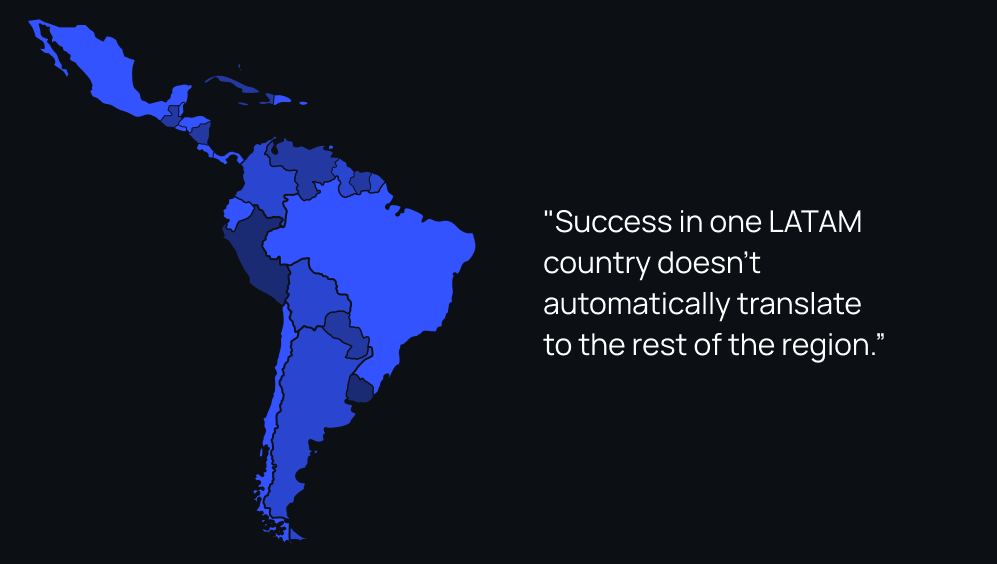
Success in one LATAM country doesn’t automatically translate to the rest of the region. Each country has its own nuances, and local relationships often matter just as much as the product itself.
That’s easy to say and harder to plan for. Latin America covers thirty-three countries and more than 650 million people, with different cultures, climates, player habits, payment preferences and regulatory regimes from one market to the next.
Language alone is a good example: most of the region communicates in Spanish, but Brazil does not, and planning for the region usually means separating North America, Central America, and the Caribbean and South American markets rather than treating them as one block. A strategy that works for acquisition in Brazil doesn’t necessarily work the same way in Mexico, Peru or Colombia. Operators that treat each market as its own business, rather than applying one LATAM approach everywhere, tend to have an easier time gaining traction than those who don’t.

Distribution decides how fast you launch
Ask me what actually delays a market entry, and licensing is not the first answer.
The biggest bottleneck is usually distribution. Most operators prefer integrating through aggregators rather than directly, so having access to the right distribution channels is crucial. In regulated markets like Brazil, every new integration also requires regulatory approval, which can significantly impact launch timelines. On top of that, operators often underestimate integration queues. Popular providers are in high demand, so if their content is compelling, you may still have to wait your turn before going live.

This is also why the aggregator relationship matters as much as it does. Rather than negotiating and integrating with each game studio separately, operators working through an aggregator connect once and gain access to a wider content library through that single integration. VeliGames, our aggregation platform, works on that model: operators get access to more than 35,000 games from over 160 providers through one API. For LATAM specifically, VeliGames offers localised content and tailored pricing, built around our presence in the region rather than a single global setup applied everywhere.
There’s also a simpler assumption that trips operators up before they get that far: that obtaining a licence is enough to succeed. A licence opens the door. However, it doesn’t decide what happens after.

The licence question
Licensing is a question every operator asks early, and my answer keeps coming back to the same point.
Local licences and certifications make business development much easier. Regulation is expanding across the region, and a Curaçao or Anjouan licence doesn’t automatically clear the way in markets such as Peru, Mexico, Argentina or Colombia, where local licensing carries more weight with operators and partners. Wherever a market has that option, working from a local licence is the more straightforward path, both for the operators I work with and for how the deal itself comes together.

Getting localisation right
If there’s one thing operators consistently underestimate, this is it.
Translating the platform is easy. Adapting content, promotions, payments, and the overall player experience to each market takes much more effort than expected. It’s a trap that catches suppliers coming from outside the region, especially often arriving with an idea of what should work rather than finding out what a given market actually wants.
In practice, that’s meant native-language customer support rather than translated scripts, mobile-first platforms built around local payment providers, and sports betting content built around the leagues players actually follow rather than only global events. The operators that do well tend to treat markets like Brazil, Mexico and Colombia as separate businesses with their own content, payment methods and marketing, rather than one strategy applied across all of them.

Ready for the rollercoaster?
There’s constant pressure to move fast in business development. My view of that pressure is measured.
Nothing is ever perfect, and it doesn’t have to be. You need to be well prepared across all key areas, but no matter how much planning you do, there may be surprises. The key is finding the right balance between speed and readiness. Operators used to more established, slower-moving markets often find LATAM moves at a different pace: closer to the difference between a train and a rollercoaster.
That doesn’t mean every shortcut is on the table. I’d never compromise on compliance or technical stability just to launch sooner. A delayed launch can be frustrating, but launching with regulatory gaps or a poor player experience usually costs much more in the long run. It’s all about reputation. Local operators tend to remember missed deadlines, and a broken commitment can cost far more than the time it seemed to save.

The long game
That eighteen-month deal is the clearest picture of what LATAM market entry tends to look like: three stakeholders, three continents, no shortcuts taken along the way.
It’s not the kind of story that fits into a pitch deck, but it’s an honest one: less a sprint, more a process worked through market by market and relationship by relationship. Across VeliTech, our platforms serve more than 40 million players and process over 100 million bets a month across the markets we operate in, figures that come from that same kind of work rather than from a single fast win.
For operators weighing up LATAM, my advice is less a checklist than an approach: get the licence, but don’t assume it’s the strategy. Build for the market in front of you rather than the region as a whole. And for my business development colleagues – expect to spend more time earning the deal than you might in other markets, because in LATAM that time tends to be part of how the deal gets made.
FAQ
A licence opens the door, but it doesn’t determine what happens afterward. Distribution is usually the real bottleneck: regulatory approval for new integrations, provider queues, and the need to work through an aggregator all shape how fast an operator can actually launch.
2. How does working with an aggregator like VeliGames change the way operators enter a market?
Instead of integrating with each game studio separately, operators connect once through an aggregator and gain access to a much wider content library. VeliGames offers more than 35,000 games from over 160 providers through a single API, along with localised content and pricing built for LATAM specifically.
3. What does it mean to treat LATAM as “a rollercoaster market” rather than “a train market”?
It means accepting that the region moves at a faster, less predictable pace than more established markets. The right approach balances speed with readiness, without cutting corners on compliance or technical stability just to launch sooner.