

About the author
Lars Kollind is a Business Development Director at VeliTech, where he focuses on driving strategic growth and aligning commercial opportunities with product direction. With over 20 years of experience in iGaming, Lars’ background spans both operator and supplier sides of the industry, giving him a practical understanding of market needs across regulated and emerging markets.
Responsible gaming is often treated as compliance. It isn’t. It is a product and system design issue.
The stronger businesses are the ones that understand sustainable entertainment depends on sustainable player lifecycles, not dark patterns. That shift is already visible across the industry: EGBA members alone sent 100 million safer gambling messages in a single year, showing that player protection is becoming more active, more continuous, and harder to separate from the product itself.
As a technology provider, our role is to support that effort by giving iGaming operators the tools to act at the right moment and in the right way. Because short-term extraction is easy. Building products that last is harder, and that is where responsible gambling really starts.
Responsible gambling by design
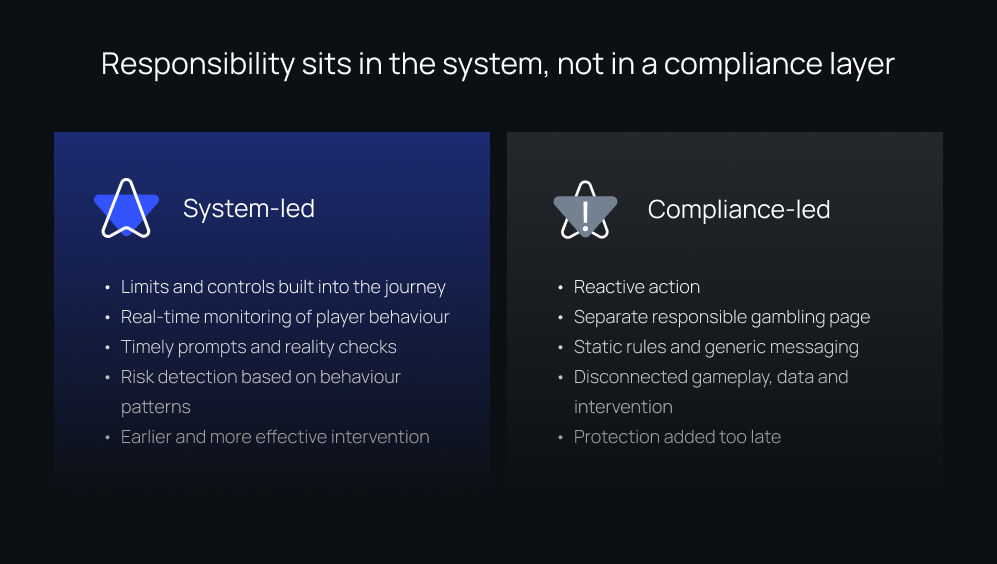
The industry has changed. What matters now is not just what the operator says on a policy page, but how the system actually works in practice. The leverage sits in the platform, the data, and the way games and journeys are built. If responsible online gambling is added later as a compliance layer, it is already too late.
That is the point of a serious responsible gaming policy. It should not sit outside the product. It should shape the product and define more than thresholds and processes. It influences how limits are surfaced, when prompts appear, what signals are tracked, and how quickly the system can respond. In other words, responsibility sits in the system itself.
Technologies that power responsible play
At VeliTech, this is how we approach it. We do not see responsibility as a single feature or a box to tick. We see it as part of how the platform is built, how data is used, and how product decisions are made across casino and sportsbook.
That matters because risk rarely begins at the moment a formal limit is crossed. It tends to show up earlier – in session length, pace of play, deposit behaviour, response to rewards, or the way a pattern starts to shift over time. The value of the platform is not that it reports those signals after the fact. It is that it can use data to act earlier.
The same logic applies to game development. Product teams shape the rhythm of the experience: how fast a player moves, what prompts appear, how visible controls are, and whether the journey creates a pause or removes it. That is why responsible conduct of gambling cannot be separated from product design. It is built into the mechanics, the messaging, and the decisions behind them.
This is also why responsible gambling tools matter only when they are part of the wider system. On their own, they are features. Connected to the platform, they become practical responsible gambling tools that support better timing, clearer interventions, and more consistent responsible gambling practices.
So let’s look at a few of the responsible gambling features built into the VeliTech platform.
Flexible limits
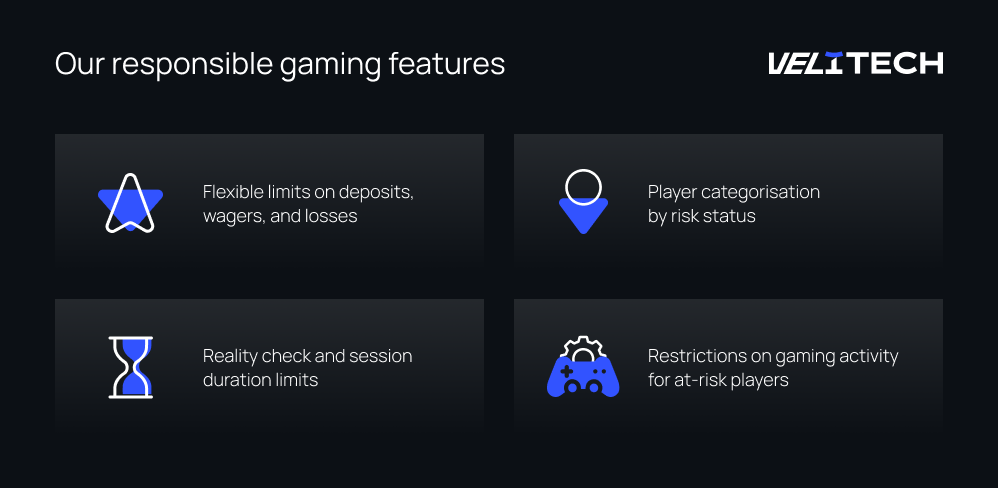
Operators using our platform can allow players to set a wide range of limits, including deposit, wager and loss limits. These remain some of the most effective responsible gambling tools casino brands can offer, but only when they are visible, easy to use, and positioned at the right moments in the journey.
That is where product design matters. A limit buried three clicks deep is not much use. A limit presented clearly around deposit flows, or after changes in behaviour, is far more effective. This is where platforms can also support better responsible gambling advice through smart prompts and contextual nudges. Through clear explanations of what each control actually does, and gentle reminders that encourage players to review their spending and gaming habits over time. When integrated thoughtfully, these measures help responsible gambling feel like a natural part of the experience rather than an interruption.
Regular reality checks
Time disappears quickly in gambling. Without the right prompts, a session can become much longer or more intense than originally intended. That is exactly why reality checks matter. They create a pause in environments designed to keep moving.
With VeliTech, operators can configure regular reminders after defined periods of play and, where needed, automatically end a session once it exceeds a pre-set time limit. They can also apply their own session rules across player groups where required.
This is particularly important in a responsible gaming casino environment, where pace and repetition can reduce awareness faster than many players realise. The goal is not to interrupt entertainment for the sake of it. The goal is to create moments of reflection before behaviour becomes harder to control and before the habit of “just one more spin” starts to take over.
Categorise players to support those most at risk
Not every player presents the same level of risk, so not every response should be the same.
With VeliTech, iGaming operators can categorise players by risk level so that communication, controls, and restrictions can be adjusted accordingly. For some players, that may mean reminders to review spending or set limits. For others, it may mean tighter session controls, bonus restrictions, or stronger intervention when signals point in the wrong direction.
This is where a real platform advantage appears. A structured responsible gambling service depends on the ability to detect patterns early, apply controls consistently, and avoid leaving every decision to manual review. To do that well, operators also need clear responsible gambling guidelines and solid responsible gaming training for the teams managing risk, retention, and player communication.
It is a balancing act
The degree to which responsible gaming is prioritised will vary from company to company. What should not vary is the foundation. If the platform is too frictionless, too opaque, or too reactive, then the problem is already built into the experience.
This is why the industry needs to stop treating responsible gambling as a statement or a late intervention. The stronger approach is to design for it from the start: in the product, in the data layer, and in the way the wider system behaves under pressure.
That is also how better products are built. A system that helps identify risk earlier, applies controls more intelligently, and supports long-term player value is not weaker commercially. It is stronger, more durable, and better aligned with sustainable growth. A player who burns out quickly may generate immediate returns, but a player who is managed responsibly is far more likely to stay active, engaged and valuable over the long term.
At VeliTech, that is the standard we aim for. We build platforms, game experiences, and control systems that help our clients deliver gambling entertainment that is sharper, safer, and built to last.
This is also a conversation I’ll be taking to the stage at AffPapa Conference Madrid on 20 May 2026, where I’ll be speaking on the panel “Who’s really responsible for Gaming?”. We’ll be discussing accountability, player protection, compliance, and the shared responsibility of building a safer industry. If you are attending, feel free to join the session.

FAQ
Responsible gambling means making sure gambling remains safe, controlled and sustainable for the player. It is not only about individual behaviour, but also about the responsible conduct of gambling across the wider experience. That includes how products are designed, how risks are identified, and how operators step in when support is needed.
2. What are responsible gambling resources?
Responsible gambling resources can take many forms. For players, they may include limit-setting features, reality checks, self-exclusion options and practical responsible gambling tips that help them stay in control. For operators, they include internal processes, technology, and clear responsible gambling guidelines that support more consistent player protection.
3. What casinos promote responsible gaming?
The casinos that promote responsible gaming most effectively are usually those that build it into the product rather than treating it as a separate compliance layer. A strong responsible gaming casino will typically combine entertaining gameplay with visible safety tools, timely interventions and a clearly defined responsible gambling policy that shapes the overall player journey.
4. How to set deposit limits for responsible gaming?
Setting deposit limits is one of the simplest ways players can manage their gambling more consciously. In most cases, this can be done through the account or responsible gaming section of the platform, where players can choose daily, weekly or monthly limits. These controls are often part of a wider responsible gambling policy and are most effective when they are easy to access and supported by clear communication.
5. What are some tips for responsible sports gambling?
For operators, effective tips for responsible sports gambling start with product and system design. That means making limits easy to access, using real-time behavioural signals to detect risk earlier, applying well-timed prompts during high-intensity betting sessions, and ensuring internal teams are supported by proper responsible gaming training.